Before the Recipe Card: How Cooks Kept Instructions
Before the recipe card, cooking knowledge lived in memory, speech, and shared work. See how writing instructions makes a dish easier to repeat and pass on.
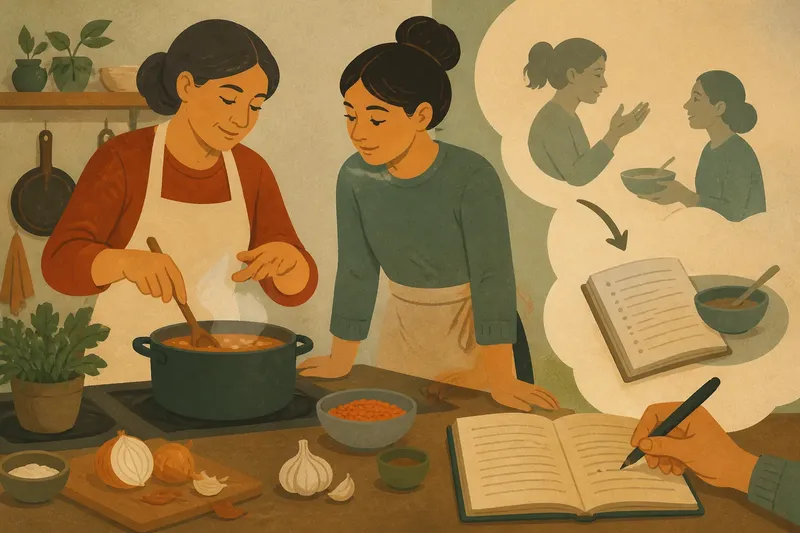
Before the recipe card, cooking knowledge lived in a voice, a hand gesture, and the smell of a pot nearing readiness. To understand how cooks kept instructions before written recipes, follow one dish from a person’s memory into words on a page. The shift is not simply from forgetting to remembering: recording a recipe changes which details travel, which remain open to judgment, and who can cook the dish without its original teacher.
What counts as an instruction before anyone writes it down?
A spoken instruction can be as brief as “add flour until it feels right,” but the words are only part of the lesson. A cook may show how the dough clings to a spoon, how a simmer sounds, or how a pinch of salt looks between two fingers. Learners pick up timing and judgment by watching, listening, and taking a turn at the work.
Much kitchen knowledge is therefore stored in people and routines rather than in a fixed script. A familiar cook remembers how a dish changes with the ingredients at hand; another person learns by helping repeatedly. Instructions can be corrected in the moment: “Not yet,” “a little more,” or “watch the edge.” The teacher can see whether the learner understands and adjust the explanation.
That kind of teaching is rich in context, but tied to a particular encounter. A learner who misses a demonstration may not know what “soft peaks” or “a lively boil” means. Even someone who knows the dish may rely on remembered cues that are difficult to explain to a newcomer.
How did cooking knowledge move between people?
Before written recipes became familiar household objects, instructions could travel through conversation, demonstration, apprenticeship, and repeated family or community practice. These routes overlap. A person might hear a dish described, watch it prepared, then make it with someone nearby who could intervene when the texture or timing seemed wrong.
Oral transmission does not mean that every cook memorized a word-for-word formula. A remembered dish might have a stable sequence—brown the onions, add the grain, then pour in liquid—while allowing the cook to judge amounts and doneness. What persists is often a way of proceeding, not a complete list of exact quantities.
These instructions can adapt as they pass from kitchen to kitchen. A cook may substitute what is available, change the seasoning to suit a household, or leave out an ingredient that is difficult to obtain. Variation is not necessarily a failure to preserve the dish. It can be part of how useful knowledge fits new circumstances.
Yet a spoken tradition has limits as a record. It can be hard to tell whether a variation is deliberate, whether a detail has been forgotten, or whether a familiar phrase depends on experience the next cook does not have. Writing offers another way to carry instructions beyond the moment and the people present.
What changes when a cook records a recipe?
Writing gives an instruction a visible, revisitable form. A reader can return to the ingredient list, follow a sequence, and compare what the recipe says with what is happening in the bowl. A note can also travel without its author: copied into a notebook, sent in a message, or placed beside the stove for another cook.
Recording makes some details easier to share. Ingredient names, order of operations, oven settings, and resting cues can be stated explicitly instead of left to demonstration. A written recipe can help a person who has never seen the dish begin with a workable plan, and it can preserve a cook’s particular choices—such as adding lemon at the end rather than at the start.
But a page cannot show every useful sign. “Cook until tender” leaves the reader to decide what tender means for that ingredient and dish. “Stir constantly” may make sense beside a pot, while a future reader may wonder how quickly to stir or what problem the instruction is meant to prevent. A recipe can preserve a cue without fully explaining how to recognize it.
Writing also changes the feel of authority. A spoken teacher can respond to the learner’s ingredients and questions; a written instruction remains the same even when the kitchen is different. It may look definitive simply because it is printed or neatly copied. Treat it instead as a record of choices, useful for repeating a dish but not a substitute for attention to what is actually happening.
How can you turn a remembered dish into a useful recipe?
Start by making the dish as you remember it, without trying to capture every motion at once. Keep a notebook or a notes app nearby. Record the ingredients as you use them, the order in which they enter the dish, and any cue that changes your next move. If you do not know an exact amount, write a plain description rather than inventing precision.
Separate fixed details from flexible ones. A fixed detail might be the order of mixing or the need to let a mixture stand before cooking. A flexible detail might be the amount of pepper, the size of a chop, or how much liquid the grains absorb. Labeling flexibility helps a new cook see where judgment belongs instead of treating every difference as an error.
Give sensory instructions something a reader can observe. Rather than writing only “cook until ready,” note what changes: the onions soften and turn translucent, the sauce coats a spoon, or the center of a piece no longer looks raw. A cue does not need to promise the same result in every kitchen; it needs to help the reader decide what to look for.
Say you remember making a family lentil soup but cannot recall how much water went in. As you cook it, you could note that the lentils were rinsed, the onion softened before the spices were added, and broth went in until it sat just above the lentils. You could also record the cue to stop simmering when the lentils yield easily but still hold their shape. The resulting note gives another cook a sequence and visible decisions without pretending that one exact volume suits every pot or batch.
After writing the first version, read it as someone who has not watched you cook. Replace private shorthand with descriptions. If a note says “do it like Mum did,” ask what action that phrase refers to. If it says “a splash,” explain what the splash is meant to accomplish, such as loosening a thick mixture or carrying spices through the pan. Where the instruction depends on a product label, manufacturer directions, or local rules, follow those rather than relying on a general recipe note.
Which details help another cook repeat the dish?
- Sequence: State what happens before what. “Add the garlic after the onions soften” gives a clearer order than a list of ingredients alone.
- State of the ingredients: Note whether vegetables are finely chopped, herbs are fresh, or beans are already cooked when that changes the method.
- Useful sensory cues: Describe a visible, audible, or tactile change that signals the next decision.
- Timing context: If you include a time, connect it to the cue it usually leads toward, rather than implying that the clock alone decides doneness.
- Flexible choices: Mark substitutions or seasoning adjustments as options, and say what they change when that is helpful.
- Serving and storage notes: Record whether the dish is meant to be served immediately or whether a later step matters, using sound food-handling guidance for the particular ingredients.
These details make a recipe more useful without turning it into a rigid contract. They also help distinguish the cook’s memory from the reader’s needs. The original cook may remember that a sauce should “look right”; the written version can name the sheen, thickness, or movement that makes that judgment easier to learn.
What questions do cooks ask about oral and written recipes?
Were recipes always written with exact quantities?
No single format describes every recipe tradition. Instructions may record ingredients and amounts, but they may also rely on shorthand, familiar vessels, sensory cues, or a sequence understood by the intended cook.
Why do family recipes often leave out details?
A note may have been written for someone who already knew the dish, so the writer did not need to explain every action. Later readers can add cues and context while keeping the original wording visible as part of the record.
Can a written recipe preserve a cook’s judgment?
It can describe what the cook watched for and what decision followed, but it cannot reproduce the whole experience of learning beside that cook. Clear sensory cues make the judgment more teachable, while the reader still develops their own attention through practice.
Should you change a recipe as you record it?
Keep the remembered version distinct from later adjustments, so you can see what belongs to the original and what you chose to change. A brief note about why you made an adjustment can help another cook understand its purpose without treating it as part of the inherited instruction.
How can a written recipe leave room for the next cook?
A good record does not have to freeze a dish. It can preserve the sequence and the cues that matter while making room for available ingredients, different equipment, and personal taste. If the dish changes, write down what changed and why; that note becomes another layer of shared kitchen knowledge, not a correction that erases the earlier version.
When you write down instructions before the recipe card, you are doing more than saving a list of ingredients. You are translating a relationship—between a cook, a dish, and a learner—into a form that can travel. Keep the cues that help someone notice what is happening, and leave honest space where judgment still belongs; that is what lets a recipe be repeated without pretending every kitchen is the same.