Why a Pan’s Shape Changes the Way Heat Meets Food
Pan shape affects contact, evaporation, and movement. Learn how width, depth, and cooking surface help match a pan to the task and avoid common cooking snags.
Your onions are steaming in a crowded skillet, or a sauce is reducing so slowly that dinner is waiting on the stove. Pan shape can be part of the problem. Width, depth, and the cooking surface influence how much food touches the hot metal, where moisture goes, and how easily ingredients move. Choosing a pan by those features—not by its silhouette alone—can make a familiar cooking task easier to manage.
Why is food steaming instead of browning?
For browning, food needs close contact with a hot surface, and the moisture it releases needs room to escape. A broad skillet gives ingredients more floor space than a narrow, deep pot. If food is piled in layers, or crowded edge to edge, released moisture collects around it. The result may look pale and wet even when the pan is hot.
Start by checking the amount of food against the pan’s flat cooking area. Spread ingredients into a single layer where the recipe calls for browning, and cook in batches if they overlap heavily. A wider pan can help, but only if its base sits securely on the burner and heats appropriately for your cooktop. A pan that is broad at the rim but has a small base may offer less useful contact area than its appearance suggests.
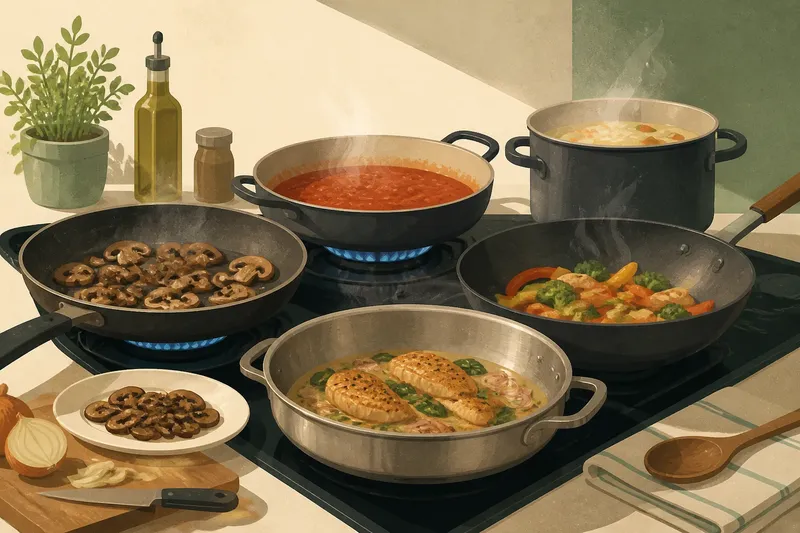
Say you are cooking sliced mushrooms in a medium skillet and they release liquid before they color. Imagine moving half to a plate, then letting the remaining slices sit with space between them. The expected observable change is less pooling around the mushrooms and more opportunity for their surfaces to dry and brown; the held-back portion can be cooked after the first batch.
Why does a sauce take so long to reduce?
Evaporation depends partly on how much exposed liquid surface the pan provides. A wide sauté pan or skillet generally spreads a shallow layer of sauce over more area than a tall, narrow saucepan. That can help water escape. A deep pot may still be the better choice when the sauce splatters, needs room for stirring, or is combined with other ingredients, but its smaller exposed surface can make reduction slower.
Before switching pans, consider what is actually slowing the process. A crowded pot, a low simmer, or a lid that traps steam may matter more than the vessel’s shape. If reducing is the goal, remove the lid when appropriate, use a steady simmer, and stir as needed to prevent sticking. Move to a wider vessel if the liquid remains deep and reduction is central to the task.
Keep the pan’s total capacity in mind. A shallow, broad vessel can be awkward when liquid bubbles vigorously or when you need to stir in vegetables without splashing. The useful choice is the broadest pan that still contains the ingredients comfortably and allows controlled movement.
Why do ingredients stick or scorch in the center?
A pan does not necessarily heat evenly from edge to edge. Its material, thickness, construction, burner size, and contact with the cooking surface all matter. Shape affects where food sits: a sloped skillet concentrates most ingredients on its floor, while a curved wok directs food toward a smaller central area. If the hottest zone is narrow, food gathered there may brown too quickly while the outer area contributes little.
Look at the pan’s base in relation to the burner. A base much wider than the heat source may leave outer food cooler; a small base over a broad burner can concentrate heat beneath a limited area. On an electric or induction cooktop, the relevant heating zone and pan compatibility also shape the result. Use a burner suited to the base, preheat according to the recipe and pan material, and redistribute food if one area is cooking faster.
If food scorches despite a suitable burner, check the cooking surface and the amount of fat or liquid called for. A scratched nonstick coating, a thin base, or residue from a previous dish can change how food behaves. For details that depend on a pan’s coating, cooktop, or manufacturer instructions, follow the product guidance.
Why is stirring awkward or food hard to turn?
Depth and side angle set the room available for movement. A deep saucepan holds liquid and helps contain splashes, but its tall sides can make it difficult to flip food with a spatula. A skillet’s low sides make turning, tossing, and checking browning easier, though they offer less protection from splatter. A sauté pan often splits the difference with a broad base and straighter, higher sides.
Match the pan to the motion in the recipe. For flipping pancakes or searing a fillet, a low rim leaves the spatula a clear path. For stirring a stew or cooking a sauce that needs frequent attention, taller sides help keep ingredients inside. If you are tossing vegetables, choose a pan with enough depth to contain them and enough open space to move them without compressing the batch.
Tools matter too. A long-handled spoon reaches a deep pot; a thin, broad spatula can slide under delicate food in a skillet. If a utensil cannot reach the bottom comfortably, or your wrist has to work around a high rim, the pan may be poorly suited to that task even if its capacity is ample.
Why do some foods cook unevenly in a wok or sauté pan?
Curved sides and sloped walls change where food rests and how it can be moved. In a wok, ingredients can be pushed up the sides while the center remains the main cooking zone. That arrangement works best when food is added in manageable amounts and moved deliberately. A standard flat-bottomed skillet, by contrast, gives a larger level area for contact but less of the wok’s curved staging space.
A sauté pan’s broad base and straighter sides are useful when ingredients need both surface contact and room for liquid. Its shape can support browning followed by simmering in the same vessel. Yet if the contents are spread thinly across a base larger than the burner’s effective heating area, the outer ingredients may lag. Stir, rotate the pan when appropriate, or use a vessel whose base better matches the heat source.
Do not assume that a pan’s named style determines how it performs on every stove. Woks designed for a particular burner may behave differently on a flat electric or induction surface. For the task at hand, pay attention to the actual base shape, the cooking surface, and the movement you need—not just the label on the handle.
Which pan shape suits which task?
Think of shape as a set of tradeoffs rather than a ranking. The best fit depends on whether the task calls for broad contact, quick evaporation, liquid containment, or room to turn food.
- Skillet: Choose a broad, relatively shallow cooking area for searing, frying, and tasks that benefit from easy access with a spatula. Its low sides make tossing simple but contain less liquid and splatter.
- Saucepan: Use a deeper vessel for simmering grains, warming liquids, and cooking foods that need containment. Its narrower exposed surface may be less convenient when rapid reduction is the priority.
- Sauté pan: Consider its wide base and higher, straighter sides for dishes that begin with browning and continue with liquid. Check that the base works with the burner and that the pan is not so large that food spreads beyond the useful heat.
- Wok: A curved interior supports pushing food up the sides and moving it around a central hot area. It is most useful when its base and shape suit the cooktop and the amount of food is kept manageable.
What should I check when a pan shape seems wrong?
Does a wider pan always brown food better?
Not by itself. A wider base can give food room to spread, but crowding, excess moisture, a mismatched burner, or insufficient preheating can still prevent browning. Look at the usable flat area and cook in batches if the ingredients cannot sit with space between them.
Should I use a deep pan to prevent splattering?
Higher sides can contain some splatter, but they also limit access for turning food and may reduce exposed liquid area. Choose extra depth when containment and stirring room matter more than easy flipping or rapid evaporation.
Why does the center cook faster than the edges?
The burner may heat a smaller area than the pan’s base, or the pan may distribute heat unevenly. Try a better-matched burner and move food through the cooking area; if the pattern persists, a different pan construction or base size may suit your cooktop better.
Can one pan handle browning and simmering?
Often, a sauté pan is a useful compromise because it offers a broad base with sides that contain liquid. For a small batch or a task needing easy flipping, a skillet may be more comfortable; for a larger volume of liquid, a deeper pot may be easier to manage.
How can you choose without buying by appearance?
Start with the action the recipe asks you to perform. If food must lie flat, prioritize a usable base that gives each piece room. If liquid must evaporate, favor a broad exposed surface while keeping splatter and stirring under control. If ingredients need frequent tossing, consider side height and angle. Then compare the pan’s actual base with the burner and account for the cooking surface you use.
For a pan shape that suits your kitchen, the important question is not which form looks most versatile in a cabinet. Ask what must touch the hot surface, where moisture should go, and how your hand needs to move. That small shift in attention can help you make a better choice from the pans you already own before deciding another one is needed.