The Quiet Logic of Letting Dough Rest
Dough resting gives flour time to hydrate and gluten time to relax, making sticky or tight mixtures easier to shape without adding more flour.
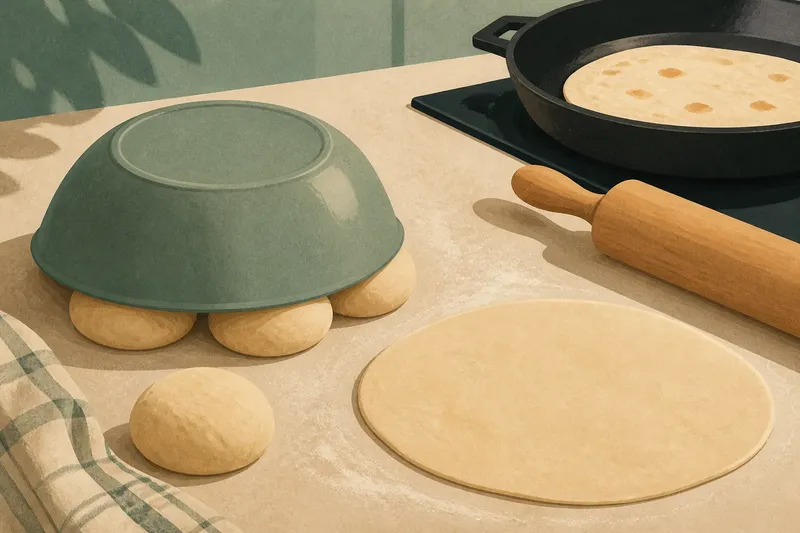
At the counter, a ball of dough keeps shrinking as Mara tries to roll it into a thin round. The recipe says to let it rest, but the bowl is already out and dinner is waiting. Dough resting is not empty time: it changes how the mixture feels and responds, often making the next move easier without changing the ingredients.
Imagine Mara is making flour tortillas from flour, water, oil, salt, and baking powder. Her dough comes together but feels slightly rough, and each pass of the rolling pin pulls it back toward the center. She covers it and leaves it alone. The pause will not repair every problem, but it can help the dough become more cooperative. The useful question is what is happening during that pause—and how to tell when it has done enough.
Why does dough resting change the feel?
Flour does not absorb water all at once. After mixing, some parts of the dough may feel dry or uneven even though the overall mixture contains enough liquid. Given time, moisture spreads through the flour. The dough can feel smoother and less crumbly without anyone adding more water.
Mixing also develops gluten, the network of proteins that gives many wheat doughs stretch and structure. That network can feel tense immediately after kneading. As the dough rests, it relaxes, so a piece that resisted stretching may yield more readily. Relaxation does not mean the dough has lost all structure; it means it is less inclined to pull itself back when shaped.
These changes are easiest to notice with doughs that need to be rolled, stretched, or formed by hand. A short pause can matter more there than in a batter poured straight into a pan. The result depends on the flour, hydration, mixing, temperature, and intended technique, so a recipe’s timing is a useful guide rather than a promise that every dough will feel identical.
What happens during Mara’s pause?
Mara gathers the tortilla dough into a rough ball and covers it with an overturned bowl. Covering keeps the surface from drying while the interior settles. She does not knead it again or dust the counter with more flour while she waits; either move could change the dough in ways that obscure what the rest itself has done.
When she returns, the rough surface looks more even. She pinches off a piece and presses it with her fingers. It spreads with less effort, and when she rolls it, the edges stay nearer to the shape she gives them. The dough still has some spring, but the pin no longer seems to be negotiating with it at every pass.
That is a practical reading of the rest. It is not necessary to expect a dramatic transformation or a perfectly smooth ball. The relevant change is in handling: the dough becomes easier to portion and roll, while its surface stays supple rather than crusting over.
How can you tell whether the dough needs more time?
Use the next action as your test. If the dough keeps snapping back while you roll it, cover it and pause again before forcing it thinner. If it tears at the edges, check whether it is dry or unevenly mixed; waiting may help moisture distribute, but it cannot supply water the dough lacks. If it spreads without much resistance and holds together, it may be ready for shaping.
In Mara’s case, the first small round still pulls inward at the rim. She covers the remaining dough and gives it another brief pause while the skillet warms. On the next attempt, the round holds its shape better. She has not used a stopwatch as the final judge; she has looked for the handling change her task requires.
- Still springing back: Cover the dough and let it relax further before rolling.
- Dry or cracked at the surface: Keep it covered; assess whether the mixture needs adjustment rather than expecting time alone to fix it.
- Soft and easy to shape: Move on, handling it gently enough to preserve that workable feel.
These cues are more useful than treating every rest as a fixed ritual. A recipe may call for a pause because it anticipates a particular flour, mixing method, or shaping task. If the dough is already relaxed and easy to work, the purpose of the pause may have been met; if it remains resistant, the clock alone does not make it ready.
Does every dough benefit from the same kind of rest?
No. A dough for rolled noodles or pie crust has different handling needs from a yeasted loaf. In rolled dough, resting often helps reduce snapback and gives moisture time to spread. In bread dough, rests may sit alongside fermentation, which brings changes related to yeast and time as well as changes in handling. A rest can serve more than one purpose, but the purposes should not be confused.
Some doughs are mixed briefly and rested before further kneading, while others are kneaded first and rested before shaping. A rest between stages can make the next round of work more manageable. For delicate pastry, excessive handling can warm or soften the mixture; resting it in a cool place may help it firm up. Follow the recipe’s direction when the method depends on temperature or fermentation, and use the dough’s condition to understand why the pause is there.
For Mara’s tortillas, the pause is chiefly about making the dough easier to roll. She does not need to treat it like bread dough and wait for it to rise. Recognizing that distinction keeps the process simple: she covers the mixture, checks its response, and continues when it stretches without a fight.
What questions do cooks ask about dough resting?
Should dough be covered while it rests?
Usually, covering helps prevent the surface from drying and forming a skin. An overturned bowl, reusable cover, or lightly covered container can work, provided it suits the dough and the recipe’s temperature needs.
Can resting replace kneading?
No. Resting can let flour hydrate and gluten relax, but it does not perform all the work of mixing or kneading. Some recipes deliberately use time between mixing stages, while others depend on active development.
Why does dough still shrink after a rest?
It may need more time to relax, or it may have been mixed in a way that leaves it especially elastic. Cover it and pause again, then shape gradually rather than pulling it hard into place.
Can dough rest too long?
It can, depending on the dough and conditions: fermentation may continue, and an uncovered surface can dry. Use the recipe’s guidance for temperature-sensitive doughs, and check appearance and feel rather than assuming all rests are interchangeable.
What does Mara learn from the finished rounds?
Mara cooks the rounds in a hot skillet, turning each as the surface develops browned spots and the dough cooks through. The important lesson came before the skillet: when rolling became easier, she stopped adding flour to solve a problem that time had already begun to ease. Extra flour could have made the dough firmer and drier, while another covered pause let her judge the original mixture more clearly.
That is the quiet logic of dough resting. It gives flour time to take up moisture and gives an elastic dough a chance to settle, so the cook can respond to what is actually in the bowl instead of fighting it. The next time dough pulls away from the rolling pin or resists a gentle stretch, cover it and wait long enough to check again. The feel of the dough—not the appearance of idle time—is the useful signal.